When evaluating Heavy Duty Cantilever Racks, load capacity is one of the most important factors affecting storage safety, structural performance, and warehouse efficiency. However, rack capacity is not determined by a single number. Two essential specifications must be considered: arm capacity and upright capacity.
Although these two ratings are closely related, they describe different load-bearing capabilities. Arm capacity indicates how much weight an individual cantilever arm can support, while upright capacity refers to the cumulative load that a vertical column can carry from the arms attached to it.
Understanding the difference helps explain how cantilever rack structures distribute loads and why both specifications must be evaluated together.
Arm capacity refers to the maximum load that an individual cantilever arm is designed to support under specified loading conditions.
Cantilever arms extend horizontally from the upright columns and directly support stored materials such as steel pipes, metal profiles, timber, lumber, and other long or bulky products. Since the arms carry the goods directly, their load-bearing performance is essential to the overall operation of the rack.
Several factors influence arm capacity:
● Arm Length: Longer arms generally create greater bending demands under the same loading conditions. Therefore, an arm's rated capacity cannot automatically be applied to another arm with a different length.
● Material and Cross-Section: The steel grade, section profile, dimensions, and thickness influence the arm's structural strength and resistance to bending.
● Load Distribution: Most arm capacity ratings are based on uniformly distributed loads (UDL). Concentrating the weight at one point or placing it unevenly can reduce the effective load-bearing capacity.
● Connection Structure: The connection between the arm and upright must transfer the applied load safely. The arm's rating should always correspond to its approved connection configuration.
For example, if a long bundle of steel pipes weighs 1,500 lbs and is evenly supported by two cantilever arms, each arm carries approximately 750 lbs. This calculation assumes that the load is distributed equally between the two supporting arms.
The important point is that arm capacity is a component-level rating. It does not represent the total load that an entire rack column or storage bay can support.
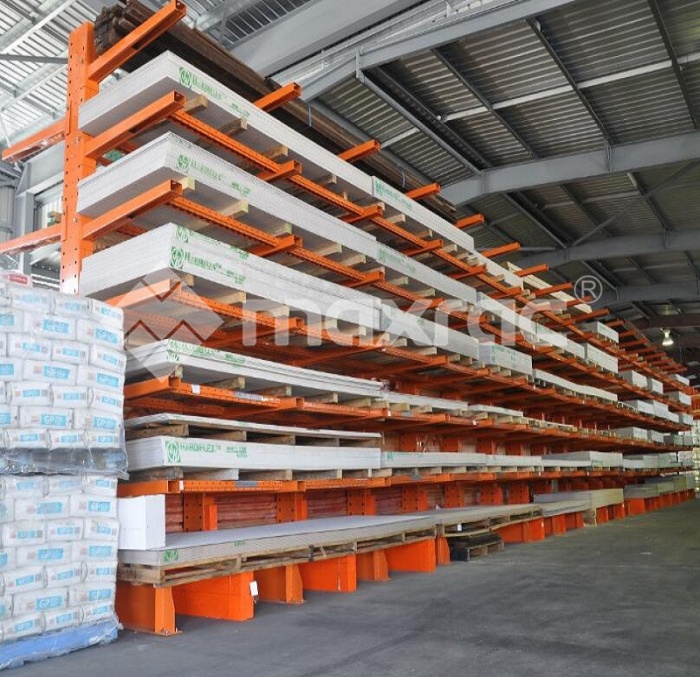
Upright capacity refers to the total load-bearing capability of an individual vertical column within a cantilever racking structure.
Unlike an individual arm, which supports a specific portion of the stored goods, the upright column receives loads from multiple arms installed at different heights.
These loads are transferred through the column and supporting structure toward the base and warehouse floor.
The required upright capacity is therefore influenced by several factors:
● Number of Arm Levels: More loaded arm positions on a column generally result in a greater cumulative load.
● Load per Arm: The weight carried by each arm contributes to the total load transferred to the upright.
● Single-Sided or Double-Sided Configuration: A double-sided upright supports arms on both sides. Loads from both sides must be considered when evaluating its capacity.
● Column Height and Structure: Column dimensions, structural profile, arm positions, and bracing arrangements influence the column's load-bearing performance.
● Load Distribution: Uneven loading between levels or sides can create different structural demands compared with a balanced loading arrangement.
Therefore, upright capacity is not simply another way of expressing arm capacity. It represents the combined loading effect of the arms connected to a particular column.
The easiest way to understand these two specifications is to examine their different structural functions.
| Comparison | Arm Capacity | Upright Capacity |
| Main component | Horizontal cantilever arm | Vertical support column |
| Load-bearing function | Supports individual stored loads | Supports cumulative loads from attached arms |
| Capacity measurement | Load per arm | Combined load supported by one upright |
| Main influencing factors | Arm length, section, connection, load distribution | Column height, arm levels, bracing, loading configuration |
| Main consideration | Local arm strength | Overall column loading |
Both ratings are necessary when designing a Heavy Duty Cantilever Racks system.
Even when every arm has sufficient individual capacity, the upright may not be capable of supporting the combined weight of all loaded arms. Conversely, a strong upright cannot compensate for an arm that is overloaded.
The actual usable capacity must satisfy both structural requirements.
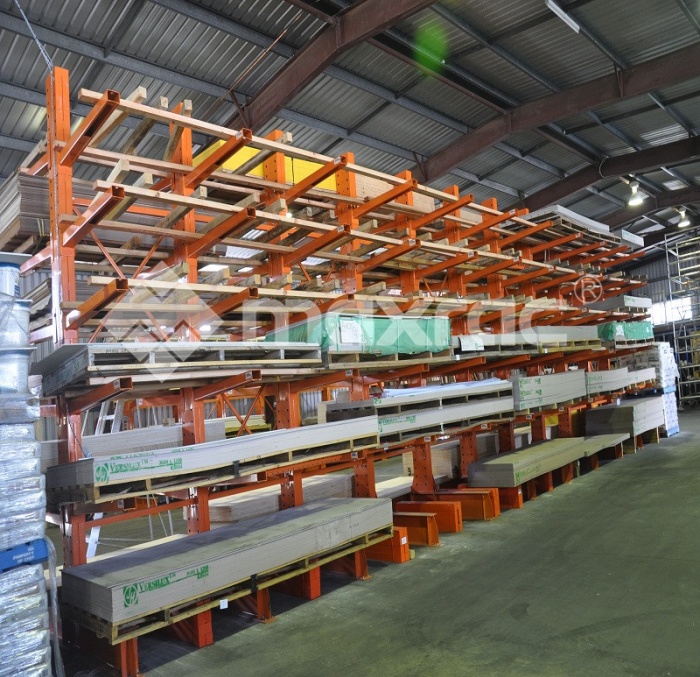
The two calculations follow different principles.
Arm Capacity Calculation
A basic calculation for determining the required capacity of each supporting arm is:
Required Arm Capacity = Total Load Weight ÷ Number of Supporting Arms
For example:
A bundle of steel materials weighs 3,000 lbs and is supported evenly by four arms.
3,000 ÷ 4 = 750 lbs per arm.
Each supporting arm must therefore have an approved capacity sufficient for its share of the load, under the specified loading conditions.
Upright Capacity Calculation
The required upright capacity is calculated by considering the cumulative loads carried by the arms attached to the column.
A simplified calculation is:
Required Upright Capacity = Sum of the Loads on All Arms Attached to the Upright
For example:
Assume a single-sided cantilever rack has four loaded arm positions on one upright. Each arm carries 750 lbs.
4 × 750 = 3,000 lbs.
The upright must therefore be designed to support at least 3,000 lbs of cumulative arm loading under this simplified loading arrangement.
For a double-sided configuration with four equally loaded arm positions on each side:
(4 × 750) + (4 × 750) = 6,000 lbs.
This example illustrates why double-sided cantilever racks require the loads on both sides of the upright to be considered.
These calculations are preliminary explanations of load distribution, not substitutes for structural design calculations or manufacturer-approved load charts. Actual ratings must account for the complete rack configuration and applicable engineering conditions.
A common misunderstanding is that selecting arms with a sufficiently high load rating automatically guarantees that the entire rack can support the required weight.
In practice, the arms and uprights work together as an integrated load-bearing structure.
Consider a rack designed for storing heavy steel pipes or large metal profiles. Each arm may be capable of supporting the weight of its assigned materials. However, when multiple storage levels are fully loaded, the combined weight transferred to the upright increases.
If the upright's rated capacity is insufficient, the rack may experience excessive structural stress even though the individual arms remain within their respective load ratings.
The reverse situation is also possible. A high-capacity upright does not make an undersized or excessively loaded arm suitable for heavy materials.
The effective capacity of the rack must be determined by evaluating all applicable component ratings rather than selecting the highest individual specification.
Arm and upright capacities are important, but they are not the only considerations in a complete cantilever rack design.
Bracing and Structural Stability
Horizontal and diagonal braces connect adjacent uprights and help maintain the stability of the rack structure. Their arrangement influences how the frame responds to applied loads and lateral forces.
Base and Floor Support
The base transfers structural loads to the warehouse floor and contributes to the stability of the rack. Floor slab strength, anchoring arrangements, and foundation conditions must also be considered.
Load Position and Distribution
Long materials should be supported at appropriate positions to avoid excessive sagging between arms. Uneven load distribution, concentrated loading, and improper placement can change the forces acting on individual components.
Storage Configuration
The number of storage levels, vertical spacing between arms, column height, and single-sided or double-sided arrangement all affect the overall structural design.
These factors explain why rack capacity should always be evaluated according to the complete installation configuration rather than isolated component ratings.
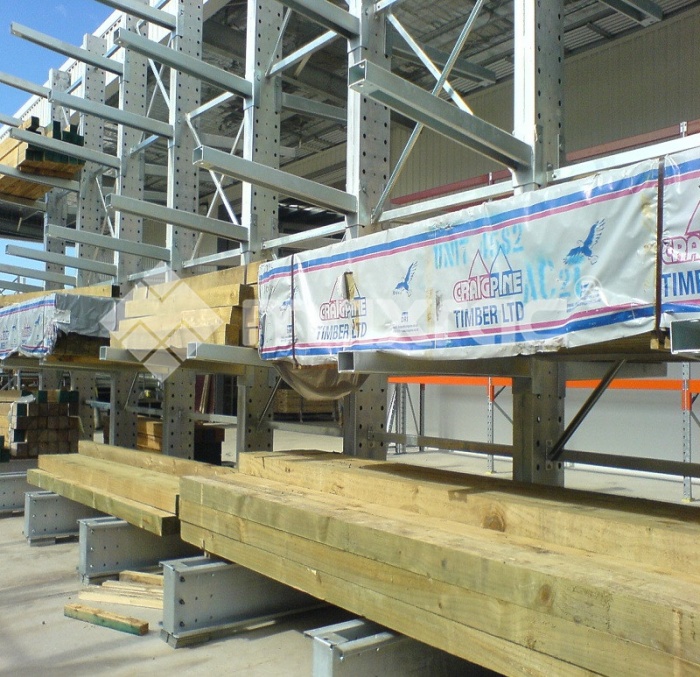
Different materials create different loading requirements for cantilever rack systems.
For example, long steel pipes may require multiple supporting arms to control material deflection, while heavy metal plates may require a different arm arrangement depending on their dimensions and weight distribution.
Lumber storage also requires appropriate support spacing to prevent excessive sagging during long-term storage.
For these applications, the relationship between arm capacity and upright capacity becomes particularly important. The number of supporting arms, individual arm ratings, number of loaded levels, and column configuration must work together to provide a suitable storage structure.
Maxrac provides Heavy Duty Cantilever Racks for storing long, bulky, and heavy industrial materials, including lumber, plates, and tubes. The system can be configured with arms on one or both sides of the upright structure, with adjustable arm elevations to accommodate different storage requirements.
The appropriate structural arrangement depends on the dimensions, weight, and storage characteristics of the materials being handled.
Arm capacity and upright capacity describe two different but interconnected aspects of cantilever rack performance. Arm capacity determines how much weight an individual horizontal arm can support, while upright capacity determines how much cumulative load the vertical column can carry from its attached arms.
For Heavy Duty Cantilever Racks, neither rating should be considered independently. Proper load distribution, arm spacing, column configuration, bracing, base support, and floor conditions all contribute to the performance of the complete storage system.
Understanding these differences provides a clearer foundation for evaluating cantilever rack specifications and designing storage structures for heavy industrial materials.
WhatsApp Contact

Scan to add Tracey



Follow us on Wechat

Getlatest projects & news instantly
Copyright © Shanghai Maxrac Storage Equipment Engineering co.,ltd. All Rights Reserved. | Sitemap
Keywords: Steel Mezzanine Radio Shuttle Mezzanine Rack Pallet Shuttle Pallet Racking System Price Mezzanine Platform Automatic Storage Warehouse Shuttle Racks Structural Steel Mezzanine 30 Deep Teardrop Pallet Rack Pallet Racking Mezzanine warehouse pallet racking systems double deep rack



 English
 Japanese
 Русский
 Español
 Français
 عربى